


The short answer: paint the lower cabinets green, keep the uppers white or cream, and add brass pulls. That two-tone setup gives you the rich green-and-gold look while the kitchen still feels bright. The lower cabinets also get kicked and scuffed, and a mid or deep green hides that far better than white.
In a dim or north-facing kitchen, pick a mid green with some warmth in it. If the room gets plenty of daylight, it can carry a deep forest or teal-black green. The rest of this page covers how to choose the green, which gold suits it, and how to paint cabinets so the finish lasts.
Choosing your green
One number helps a lot: the color’s LRV, or light reflectance value. It’s listed on each color’s page on the maker’s website. Sherwin-Williams explains it as how much light a color reflects, from 0 (none) to 100 (all of it). A low number means a dark color that soaks up light.
Four well-known greens. Three are quoted in their maker’s words. Pewter Green has no maker description, so that one is ours:
- Saybrook Sage (Benjamin Moore HC-114), LRV about 45. “A soothing aloe hue cooled with a splash of gray.” A mid green, and the gentlest choice here.
- Pewter Green (Sherwin-Williams SW 6208), LRV about 12. Sherwin-Williams classes it as dark. In our words, it’s a muted green with a lot of gray in it.
- Narragansett Green (Benjamin Moore HC-157), LRV about 9. “A blackened teal that conveys a strong sense of history and architectural relevance.” Deep and moody.
- Salamander (Benjamin Moore 2050-10), LRV about 6. “A deep, dark mix of black, blue, and green, this color is an intriguing chameleon.” In low light it reads almost black.
Undertone and your light
Greens change more than most colors from room to room, because every green leans toward yellow, gray or blue. That lean is called its undertone. Here’s how we’d read the three main kinds:
- Olive and yellow-leaning greens look warm and earthy. They’re the friendliest in a dim room.
- Gray-leaning greens like sage look calm and soft. In cool light they can turn grayer than you expect.
- Blue-leaning greens like teal look crisp and dramatic. In cool light they can read nearly blue.
Your room’s light pushes the color one way or the other. Sherwin-Williams says north-facing rooms get the least light, and advises warm colors there and avoiding cool undertones, which make the room feel colder. South-facing rooms get warm light all day, so even a cool green looks more neutral.
Your bulbs matter too. Energy Star explains that light color is measured in Kelvin (K). Lower numbers, like 2700K “soft white,” look yellowish. Higher numbers look whiter or bluer. A sage that looks gray at noon can look olive under 2700K bulbs at night.
So test it properly. Paint a large sample on a cabinet door or a board, and check it in the morning, in the afternoon and under your evening lights.
Two-tone: green below, light above
Two-tone cabinets are the easiest way to use a strong green without making the kitchen feel smaller. A green island alone is the lowest-commitment version: one piece to repaint, not the whole kitchen. An all-green kitchen works with a mid green like sage. With a very dark green, it needs a big window or plenty of under-cabinet light.
For the light uppers, choose a white that suits the green. Two Benjamin Moore whites, in the maker’s words:
- White Dove (OC-17), LRV about 83. “Unerring style defines this clean and classic white.” Our pick next to warm or olive greens, because it’s softer than a stark white.
- Chantilly Lace (OC-65), LRV about 90. “A classic go-to white that elicits images of fresh cotton and pure silk.” Our pick for crisp contrast with deep and blue-leaning greens.
If you like the plan but not the color, the same split works with navy. See blue lower kitchen cabinets.
Picking the gold hardware
These pairings are our opinion:
- Sage and other mid greens: brushed brass or a pale champagne gold keeps the soft look.
- Deep greens: a warmer, darker brass, including unlacquered brass that darkens as it ages. Against a very dark green, a bright yellow gold can look cheap. A deeper brass looks richer.
- Keep one gold family. Match the pulls, the faucet and any light fixture as closely as you can.
Measure the hole spacing on your old pulls before you buy new ones. For which gold finish lasts and how to clean each one, see our guide to gold kitchen accents.
Counters and backsplash that go with green
Green cabinets carry a lot of color, so let the counters and walls stay quiet:
- Counters: white or light quartz, or a light marble look, keeps it crisp. Butcher block warms it up and looks right with sage and olive.
- Backsplash: white or cream subway tile is the easy win. A cream tile softens a dark green better than stark white. Our subway tile backsplash ideas cover the layouts.
- Walls: match the white you chose for the uppers, or use a very pale tint of your cabinet green.
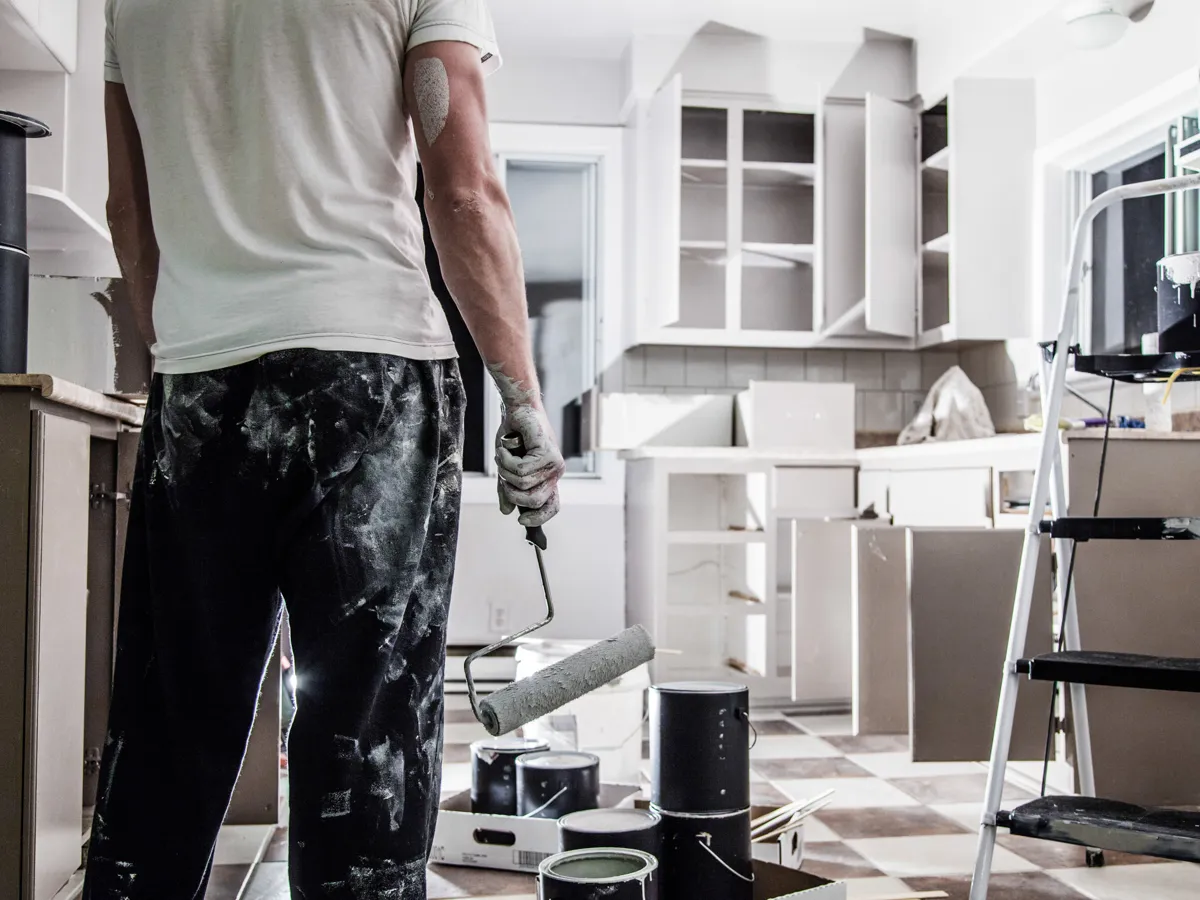
How to paint the cabinets so it lasts
Cabinet paint fails when it goes on over grease, or gets used before it has hardened. Sherwin-Williams’ five-step method:
- Take off the doors and hardware. Paint on hinges and pulls is the classic giveaway of a rushed job.
- Degrease everything. Kitchen cabinets carry a film of cooking grease. Clean them with a degreaser, then fill any holes with wood filler. Sherwin-Williams says most clean surfaces may not need sanding before its bonding primer (Extreme Bond Primer). Test the primer on a hidden spot and let it dry to check that it sticks.
- Let the primer dry at least 24 hours, then sand lightly with very fine sandpaper and wipe the dust off with a damp cloth.
- Brush, then roll. Brush the grooves and edges first, then roll the flat parts right away with a small roller to smooth out brush marks. Sherwin-Williams uses its Emerald Urethane Trim Enamel in satin, semi-gloss or gloss.
- Wait about 24 to 48 hours between coats, and another 24 to 48 hours before putting the hardware back on.
Benjamin Moore’s Advance paint is another common cabinet choice. Its data sheet lists 4 to 6 hours to dry to the touch and 16 hours before a second coat. It says the paint can take up to 30 days to reach full hardness, depending on weather and drying conditions. Treat new doors gently for the first few weeks.
Before you sand: the EPA says homes built before 1978 are more likely to have lead paint. To find out, the EPA suggests hiring a certified lead inspector or risk assessor. If there is lead, don’t try to remove it yourself. The EPA says to hire a lead-safe certified contractor. Sherwin-Williams also warns that sanding old paint can release lead dust, and recommends a fitted respirator.
Common questions
Will dark green cabinets make my kitchen feel smaller?
They can if every cabinet is dark and the room gets little daylight. Keeping the uppers light and adding under-cabinet lighting fixes most of that. If the kitchen is small and faces north, start with a mid green instead.
Can I paint laminate or thermofoil cabinets green?
Often, yes, with the right primer and prep. Sherwin-Williams says its Extreme Bond Primer and Emerald Urethane Trim Enamel are “especially recommended for laminate cabinets.” Benjamin Moore’s Advance data sheet covers wood, MDF and thermofoil cabinets, and says to rough up all surfaces by sanding before priming. Peeling or bubbling thermofoil is a different problem. Fix or replace it, because paint won’t hold it down.
Should the cabinet boxes and the doors be the same green?
Yes, unless you’re going for a deliberate two-color look. Painting only the doors leaves the old color showing at the edges and between them, and that looks unfinished.
Sources
- Benjamin Moore: Saybrook Sage HC-114
- Benjamin Moore: Narragansett Green HC-157
- Benjamin Moore: Salamander 2050-10
- Sherwin-Williams: Pewter Green SW 6208
- Benjamin Moore: White Dove OC-17
- Benjamin Moore: Chantilly Lace OC-65
- Sherwin-Williams: Choosing paint colors by room direction (LRV)
- Energy Star: Light bulb purchasing guide (color in Kelvin)
- Sherwin-Williams: How to paint kitchen cabinets in 5 steps
- Sherwin-Williams blog: How to paint kitchen cabinets (laminate answer)
- Benjamin Moore: Advance high gloss N794 technical data sheet
- EPA: Protect your family from sources of lead

