


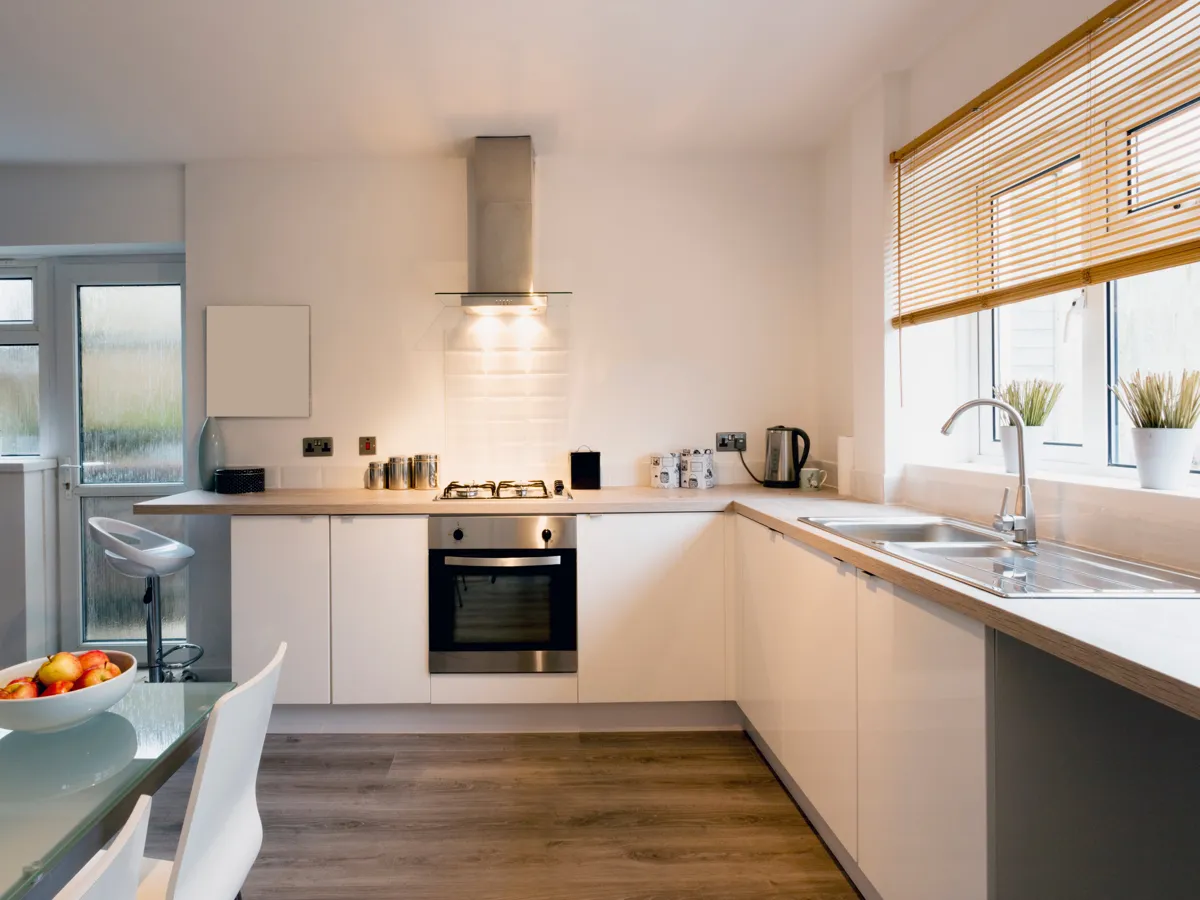
The short answer: a minimal counter holds only what you use every day, grouped in one or two spots, with everything else behind a door. For most kitchens that’s the coffee maker, a knife block or utensil crock, and one tray by the stove. Clear the rest, and the counter does most of the decorating for you.
What earns a spot on the counter
Our rule: if you don’t use it at least most days, it doesn’t live on the counter. Walk through a normal week and notice what you actually reach for. For most people the list is short:
- The coffee maker or kettle. It gets used daily and is a pain to lift in and out of a cabinet.
- One utensil crock by the stove with the spatulas and spoons you really use. Not every utensil you own.
- Knives, in a block or on a wall magnet.
- Salt, pepper and oil on a small tray next to the stove, so they read as one item instead of five.
Everything else (toaster, stand mixer, blender, air fryer) goes behind a door. If you make toast once a week, the toaster lives in a cabinet.
Where everything else goes
Clearing the counter only works if the things have a home that’s easy to reach. Otherwise they creep back.
- A lower cabinet near an outlet for the appliances you use weekly. Store each with its cord and parts so it comes out in one lift.
- A deep drawer to store the toaster or a small air fryer when it’s cool.
- An appliance garage, a cabinet with a door that sits on the counter, if you’re renovating anyway. It hides the coffee maker or toaster between uses.
- A pantry shelf or high cabinet for the once-a-month things: the slow cooker, the waffle iron, the big serving platters.
One safety rule: a drawer or garage is for storage, not for cooking. Slide a toaster, air fryer or coffee maker out onto open counter before you turn it on, and give it the clearance its manual asks for. Let it cool before it goes back.
Fruit bowls, cookbooks and plants are fine, as long as you pick one and give it a place. That’s the difference between “styled” and “cluttered”.
Minimal counter decor that works
Minimal doesn’t mean empty. A few chosen pieces make a kitchen look lived-in and calm at the same time. What we’d do:
- Group in threes, on a tray or board. A wooden board with the oil bottle, a salt cellar and a small plant looks deliberate. The same things spread out look messy.
- Leave one long stretch completely bare. Usually the counter between the sink and the stove. That’s your work space, and it’s what makes the room feel open.
- Repeat one material. Wood boards, a wood utensil crock and a wood bowl tie together. So do a few brass or gold pieces; see our gold accents guide.
- Light it. Under-cabinet lights or pendants over an island make a clear counter glow at night. See our island and bar pendant guide.
- Let the backsplash be the art. A clean tile wall behind a clear counter looks finished. Our subway tile backsplash ideas show layouts that do this well.
Countertop surfaces that suit a minimal look
If you’re replacing counters, pick a surface that looks calm and is easy to keep wiped. Three common choices, with what the makers say about care:
Quartz. Solid colors and soft veining look clean, and in our view it’s the easiest of the three to live with. Caesarstone says its quartz is “highly nonporous”, so it doesn’t soak up spills. Caesarstone’s care advice: wipe with warm water and a mild detergent, always put hot pans on a trivet or hot pad, and use a cutting board. It names products to keep off it, including oven and grill cleaners, dishwasher detergent, floor strippers and oil soaps. Other quartz brands: check your maker’s care page.
Solid surface (like Corian). We like it for a minimal look because a solid color reads as one calm surface. Corian’s care text, as published by a Corian fabricator, says to keep hot pots and pans off it and never cut on it, because knives score it. The upside: most damage, including impact, heat or chemical damage, can usually be repaired on site. Dark colors show scratches more than light ones.
Butcher block. Warm wood softens a white or modern kitchen. It needs the most care. John Boos, the butcher block maker, says to wipe it with mild soap and water and dry it with a towel. For an oil-finished top, oil it at least once a month, depending on how much you use it. (A varnished or sealed top follows its own maker’s care guide.) Don’t let water, meat juices or other liquids sit on it for long, because they soak in and make the wood swell and soften.
Our pick for a clean, low-fuss counter is a white or light gray quartz. Pair it with white cabinets and the kitchen reads bright and open.
Common questions
Can I keep the toaster or air fryer in an appliance garage?
For storage, yes. To use it, we’d always slide it out onto open counter first. Toasters and air fryers give off heat and need space around them, so check the appliance manual for how much clearance it needs. If you’re building a garage, put an outlet inside it so cords don’t trail, and make it deep enough that the appliance slides out easily.
Can I set a hot pan on butcher block?
We wouldn’t. Heat can scorch or dry out the wood and mark the oil finish. Use a trivet, the same as you would on quartz or solid surface. A trivet that lives by the stove is one counter item that earns its spot.
Do I need to seal quartz counters?
Caesarstone doesn’t call for sealing; it describes its quartz as nonporous and non-absorbent. Natural stone like granite and marble is different, so check your installer’s or maker’s care guide. See Caesarstone’s care page for its full advice.
