


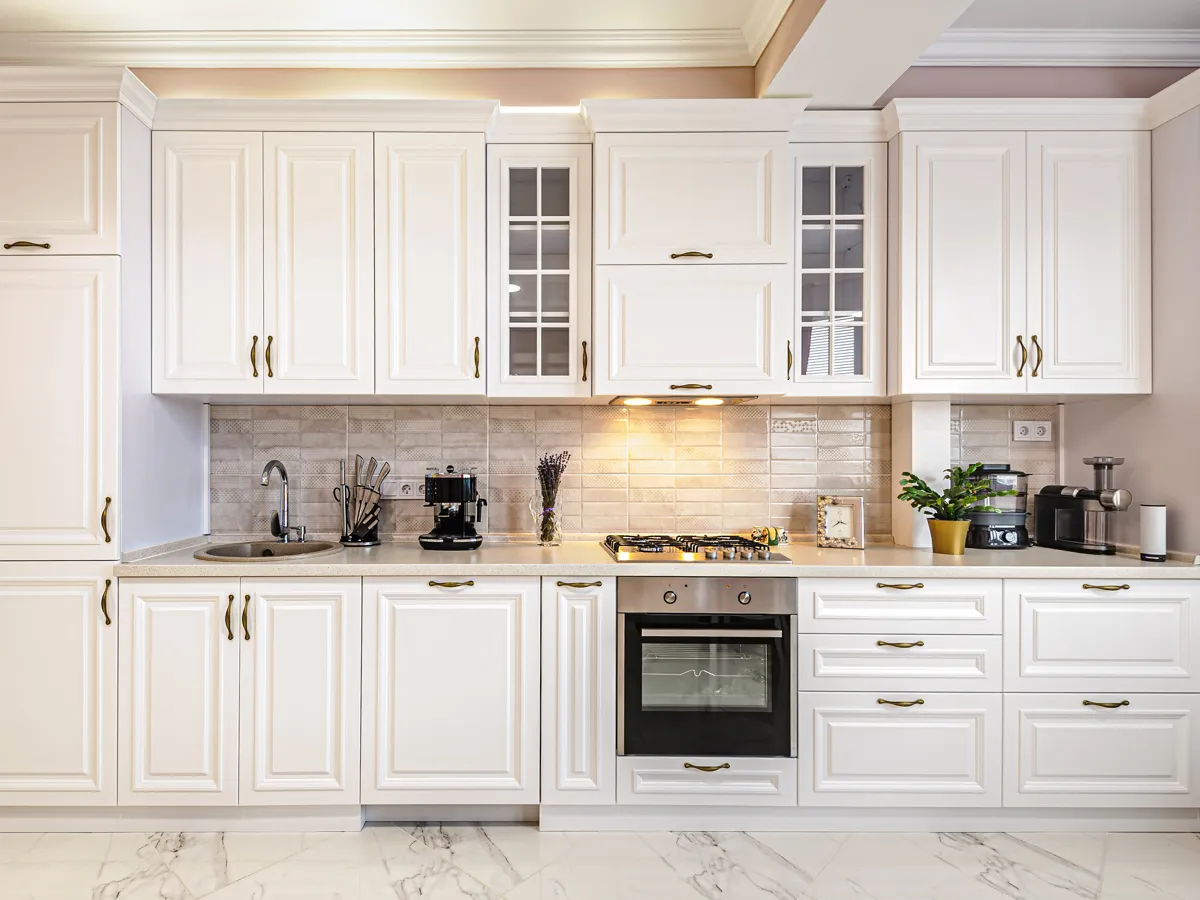
The short answer: pick a soft white with a touch of warmth, like Benjamin Moore’s Simply White or White Dove, unless your kitchen gets strong, cool daylight and you want it crisp. Then paint a sample board of each white you’re considering, at least the size of a sheet of paper. Look at them on your cabinets, morning and night, before you buy a gallon.
The catch is that “white” is hundreds of colors. Some read cold and blue, some read creamy, and the same can of paint looks different under your bulbs than in the store.
How to choose a white
Start with two questions: how much light does the room get, and what’s staying? Your counters, floor and backsplash all have their own undertone, a faint hint of yellow, pink, green or blue under the main color. The cabinet white should agree with them, not fight them.
- Warm whites have a little yellow or red in them. They look soft and calm, and they’re kind to wood floors, beige stone and brass hardware. In a dim kitchen they keep the room from looking gray.
- Cool or clean whites have little or no yellow. They look crisp and bright, and they suit gray or white quartz, black hardware and steel appliances. In a dark room they can look a little gray or flat.
- If you’re not sure, pick a white with just a hint of warmth. It’s the safest choice in most kitchens.
Paint makers rate each color’s LRV, short for light reflectance value. It’s a number from 0 (black) to 100 (a perfect white) that tells you how much light the color bounces back. A higher number looks brighter. The three whites below run from about 83 to 90.
Three whites worth sampling
These are three of Benjamin Moore’s best-known whites, with the maker’s own LRV and description. The warm or cool reading is ours.
- Chantilly Lace (OC-65), LRV 90.04. Benjamin Moore calls it “a classic go-to white that elicits images of fresh cotton and pure silk.” It’s the brightest of the three and reads clean, with very little yellow. Pick it for a modern kitchen with cool-toned counters and lots of daylight.
- Simply White (OC-117), LRV 89.52. Benjamin Moore says “the slightest hint of warmth makes this clean, crisp white a favorite to use anywhere in the home.” Almost as bright as Chantilly Lace, a touch softer. If you only sample one, sample this.
- White Dove (OC-17), LRV 83.16. Benjamin Moore’s description: “Unerring style defines this clean and classic white.” It’s noticeably softer, with a gentle warmth. It’s our pick for Shaker-style doors (flat panels inside a plain square frame), wood floors and brass or gold pulls.
Tape your sample boards to a cabinet door. Check them by daylight and again at night under your own bulbs. In our experience bulb color shows up most on white, so see our kitchen lighting guide if your lights look yellow or blue.
Painting the cabinets you have
Painting existing cabinets is a big weekend (or two) of work, but it’s mostly prep and waiting. Here’s the process Benjamin Moore lays out, with two tips of our own marked:
- Take everything apart. Remove doors, drawer fronts and hardware. Lay pieces flat where they can dry for a few days, and tape a drop cloth over the counters. (Our tip: label each door and its hinges with tape so they go back in the same spot.)
- Degrease. Wash every surface with a grease remover and a damp sponge, then let it dry. Paint won’t stick to kitchen grease.
- Scuff-sand. Use 100- to 150-grit sandpaper, just enough to dull the shine so primer can grip. You don’t need to sand off the old finish. Wipe the dust off.
- Prime. Benjamin Moore recommends its Fresh Start High-Hiding All-Purpose Primer, and warns not to use a lacquer-based primer, which can keep the paint from sticking. Let it dry at least an hour.
- Sand lightly, then paint. Smooth the primer with 220-grit paper, wipe, and brush or roll on the first coat. A brush does edges; a small roller does flat panels. Let it dry, sand lightly with 220 again, and add a second coat.
- Wait before you rehang. Let it dry in a well-ventilated area for at least 24 hours (two or three days is better) before putting doors back. Avoid heavy abrasion or cleaning for 5 to 7 days.
Benjamin Moore’s guide uses its Advance cabinet paint, and says to paint when it’s between 50°F and 90°F. Check the label of whatever paint you use for its own drying times. (Our tip: if your cabinets are laminate or thermofoil, ask at the paint counter about the right primer before you start.)
Keeping white cabinets clean
First, wait. Benjamin Moore says to let new paint fully cure before you clean it: at least 30 days. Before then, only spot-clean, very carefully. After that, white shows fingerprints near the handles and splatter near the stove, so plan on a quick wipe each week. Benjamin Moore’s cleaning advice for painted cabinets:
- Use a soft sponge with mild soap and slightly warm water.
- Skip abrasive pads and “magic eraser” sponges, and harsh cleaners like bleach, ammonia or alcohol. They can dull or wear the paint.
- Dab at marks rather than scrubbing, then wipe with a clean damp cloth and blot dry.
- Don’t hang wet dish towels over the doors. Benjamin Moore says lingering moisture can cause problems.
Our tip: put pulls or knobs on every door, so hands touch metal instead of paint. In our experience a slightly softer white like White Dove also hides light smudges better than the brightest whites.
What to pair with white cabinets
White is a backdrop, so the other choices give the kitchen its personality. Our picks:
- Backsplash: classic white subway tile is the safe match, and grout color sets the mood (white for calm, gray for definition). See our subway tile backsplash ideas for layouts that look current.
- Hardware: brass or gold warms up a white kitchen fast and pairs best with warm whites. Black looks sharp with cool whites. Our guide to gold kitchen accents covers finishes and how much is too much.
- Counters: white or light gray quartz looks clean; butcher block adds warmth. Keep them clear and the whole room looks bigger (see our minimal countertop guide).
- A second color: if all-white feels flat, paint only the lower cabinets or the island a deeper color and keep the uppers white. Green with gold hardware is a favorite; see green lower cabinets with gold accents.
Common questions
Which sheen should I use on cabinets?
Benjamin Moore’s cabinet guide uses its Advance paint in satin or high-gloss. In our experience, shinier paint wipes clean more easily but shows brush marks and dents more. We’d pick satin for a softer look.
Is it cheaper to paint or replace cabinets?
Painting is far cheaper if the boxes are solid and you like the layout, since you’re mostly buying primer, paint and supplies. Replace them if the boxes are damaged by water or you want to change the layout. For more ways to stretch a budget, see our budget kitchen remodel tips.

